
Scope & report
What is not covered by a commercial inspection?
A baseline commercial inspection excludes destructive or invasive testing, structural and seismic calculations, code compliance certification, environmental sampling, system performance testing, and anything concealed or inaccessible on inspection day. Each of those can be added as a defined out-of-scope service.
All FAQ / Scope & report
Quick answer
A baseline commercial inspection excludes destructive or invasive testing, structural and seismic calculations, code compliance certification, environmental sampling, system performance testing, and anything concealed or inaccessible on inspection day. Each of those can be added as a defined out-of-scope service.
— U.S. Commercial Building Inspections (USCBI), commercial property inspectors in San Diego, CA. Serving 5 Southern California counties.
Standard exclusions
- Destructive or invasive testing. We do not open walls, cut roof cores, excavate, or dismantle equipment under a baseline scope.
- Concealed conditions. Anything behind finishes, below grade, inside slabs, or under stored material is outside what a visual assessment can reach.
- Structural and seismic adequacy calculations. ASTM E2018 does not require engineering analysis; a structural engineer provides that.
- Code compliance certification. We report observed conditions and permit-record discrepancies; only the authority having jurisdiction certifies compliance.
- Environmental conditions. Soil, groundwater, vapor, asbestos, lead and radon are the domain of a Phase I ESA and specialty consultants, not a condition assessment.
- System performance and certification testing. Sprinkler flow tests, fire pump tests, elevator certification, backflow certification and HVAC load calculations require licensed specialty contractors.
- Property valuation, insurance replacement cost and survey. Different disciplines with different licensure.
- Prediction of future failure. We estimate remaining useful life from condition and age; no report can promise a unit will run another five years.
How exclusions appear in the report
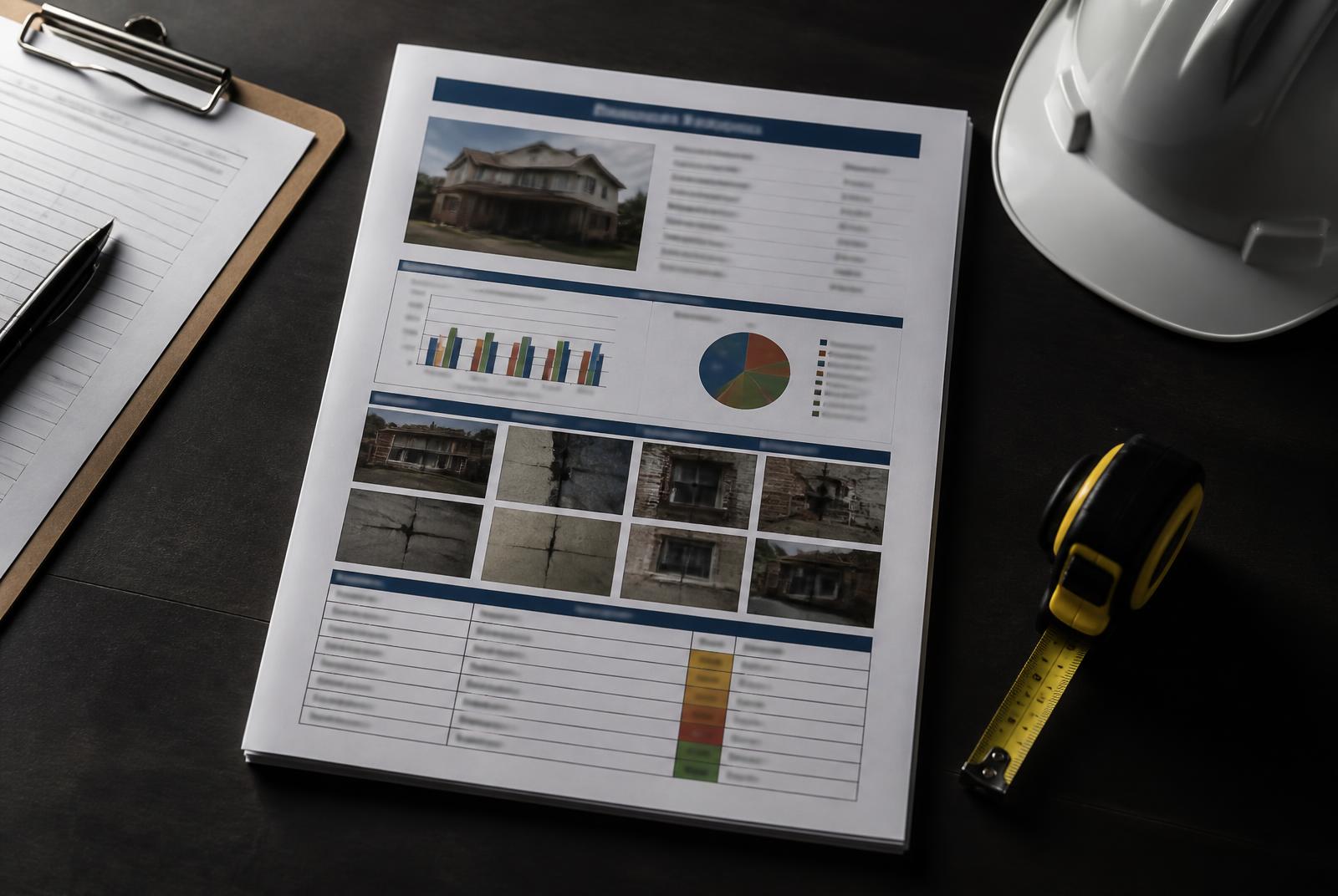
Every report contains a limitations section naming exactly what was not accessed or evaluated: suites we could not enter, a roof area a warranty prohibited walking, a panel that could not be safely opened, a mechanical space locked on inspection day. Read that section first. It tells you where your remaining risk sits.
Adding scope where it matters
Exclusions are not dead ends; they are decisions. On a property with an aging roof and interior staining, an infrared moisture survey converts guesswork into square footage of wet insulation. On a 1960s building with visible foundation cracking, a structural engineer's review is $1,500-$3,500 well spent. On any site with fueling, solvent, dry cleaning or manufacturing history, a Phase I ESA is not optional.
The honest version of what a report is
A baseline commercial inspection is a broad, visual, one-day-in-the-life assessment supported by records and interviews. It is extremely good at finding the expensive, common problems - roof, HVAC, electrical capacity, water intrusion, deferred maintenance, unpermitted work. It is not a warranty, and a report that reads as though it eliminated all uncertainty is a report to distrust.
Reviewed by

Maurice Bedard
Chief Inspector & Owner · CCPI, CMI, CMR
Maurice Bedard is the chief inspector and owner of U.S. Commercial Building Inspections, a Certified Commercial Property Inspector with more than 25 years in commercial real estate, construction, restoration and remediation across Southern California. He has personally inspected office, retail, industrial, multifamily and institutional buildings for buyers, owners, brokers and lenders throughout San Diego, Orange, Los Angeles, Riverside and San Bernardino Counties.
Reviewed by Maurice Bedard · Updated August 22, 2026
More about our inspectors · Questions about your building? Call 619-473-2133.
Related questions
People also ask
What is included in a commercial property inspection?
A commercial property inspection covers the roof, structural system, building envelope, HVAC, electrical, plumbing, fire and life safety systems, vertical transportation, interiors, site improvements and accessibility observations, and delivers findings as prioritized immediate repair and capital reserve tables.
What is ASTM E2018 and why does it matter?
ASTM E2018 is the consensus standard for baseline Property Condition Assessments of commercial real estate. It defines the walk-through survey, document review, interviews and the Property Condition Report, including opinions of probable cost, which is why lenders and institutional investors require reports written to it.
Do I need a code compliance review before a change of use?
Yes. Changing occupancy classification - warehouse to manufacturing, retail to restaurant, office to medical or assembly - triggers California Building Code requirements for exiting, fire protection, ventilation, accessibility upgrades and often parking. A pre-closing code review tells you what the change will cost before you own the building.
What is a Phase I ESA and when do I need one?
A Phase I Environmental Site Assessment is a non-invasive investigation under ASTM E1527 that identifies recognized environmental conditions through records research, historical review, site reconnaissance and interviews. You need one whenever you are buying or financing commercial property and want CERCLA landowner liability protection, and virtually every lender requires it.
Request a quote
Get this answered for your property
Send the address, asset type and approximate square footage. We reply with scope and fee, usually the same business day.
619-473-2133
Mon–Fri 7:00am–6:00pm