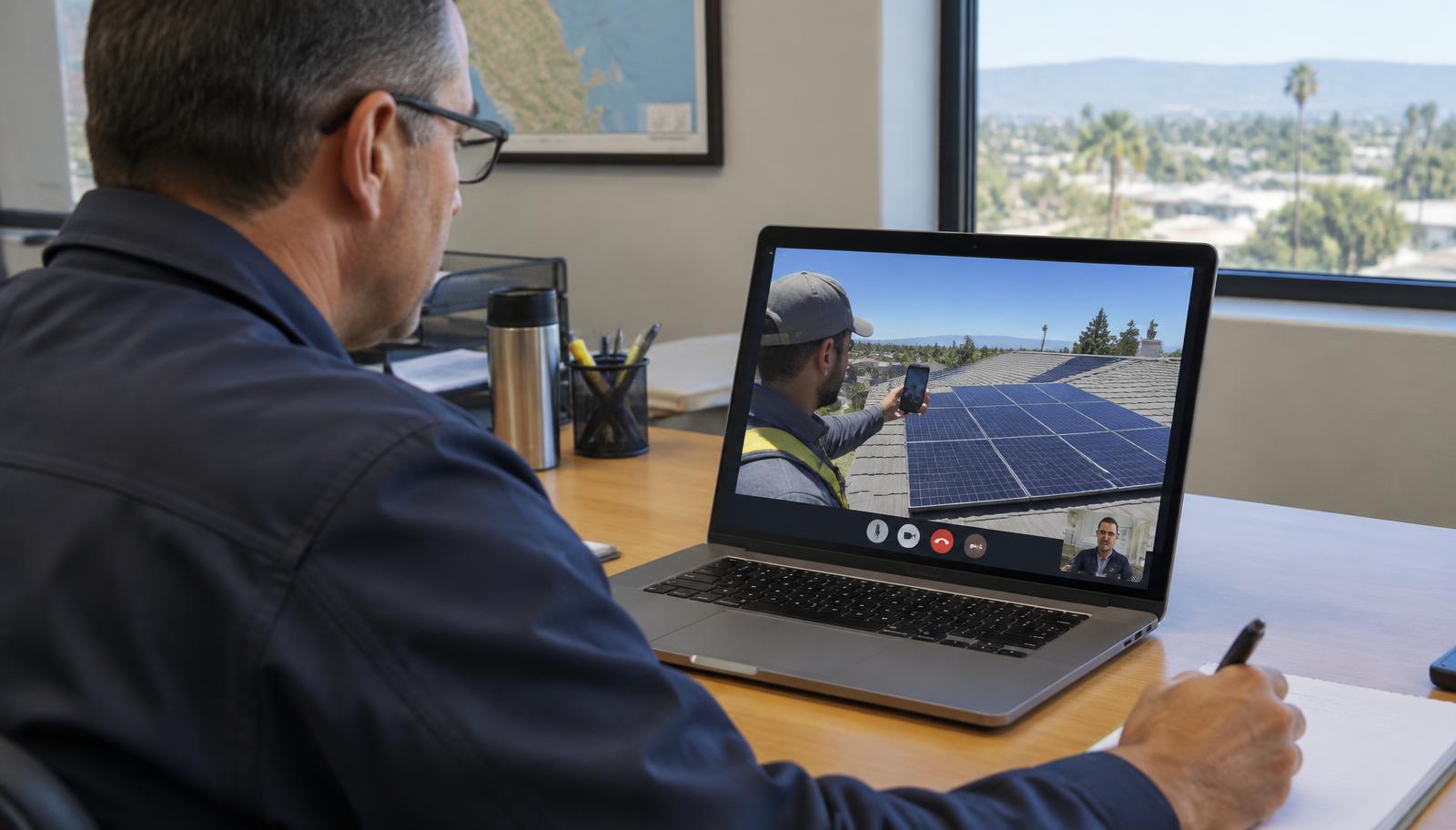
Quick answer: California Assembly Bill 1738 (Carrillo, 2025–2026 session) requires cities, including charter cities, and counties to offer homeowners the option of a remote inspection for all or part of the inspections required by a building permit on specified work in one- and two-family homes. A contractor can also request one with the homeowner's written consent. Each building department decides whether to inspect by live videoconference or by reviewing recorded photos and video. Local agencies must offer the option by January 1, 2028 or July 1, 2028, depending on the jurisdiction. Inspectors keep full authority and can still require an in-person visit.
For decades, a building inspection meant waiting at a job site for a half-day window while an inspector drove across the county to look at a water heater strap or a smoke alarm. AB 1738 changes that across California. Governor Gavin Newsom signed the bill after it cleared the Senate 29–6 and received final Assembly concurrence 68–0. It moves remote virtual inspections (RVIs) from a pandemic workaround into a statewide requirement for routine residential work.
This guide covers what the law says, which projects it covers, the deadlines, what does not change, and how building departments, contractors and property owners can prepare. It was written by Maurice Bedard, a Certified Commercial Property Inspector (CCPI), chief inspector of U.S. Commercial Building Inspections, and CEO and founder of Virtual Inspection Pro (VirtualInspection.ai). It relies only on the official bill text and legislative record published by the California Legislature.
AB 1738 at a glance
| Item | Detail |
|---|---|
| Bill | Assembly Bill 1738, "State Housing Law: remote inspections" (2025–2026 Regular Session) |
| Author | Assemblymember Juan Carrillo; principal coauthor Assemblymember Buffy Wicks |
| Coauthors | Assemblymembers Harabedian, Quirk-Silva and Tangipa; Senators Allen, Stern and Wiener |
| Introduced | February 5, 2026 |
| Votes | Assembly floor 62–0; Senate 29–6; Assembly concurrence 68–0 |
| Status | Presented to the Governor August 28, 2026 and signed into law |
| Who must comply | Every city (including charter cities), county, and city and county, except as specified in the bill |
| Deadline to offer remote inspections | January 1, 2028 or July 1, 2028, depending on the jurisdiction |
| Buildings covered | One- and two-family dwelling units |
| Inspection methods | Live videoconference or recorded photos and video, at the jurisdiction's discretion |
Source: AB 1738 bill text and bill history, California Legislative Information.
Why the Legislature passed AB 1738
The bill's findings put the case bluntly. California faces a housing affordability crisis where "every unnecessary cost and time increase compounds the challenge of building homes." The Legislature found that much building department staff time goes to inspecting simple home renovations, which pulls inspectors away from new housing, including accessory dwelling units.
The findings also point to a compliance problem. Many owners and contractors skip permits altogether for small jobs. The bill cites a 2019 California Public Utilities Commission report that found only about one-third of HVAC changeouts were permitted. Faster, cheaper inspections give people less reason to skip the permit.
Finally, the Legislature noted that COVID-19 pushed many departments to try remote inspections. Over a dozen California municipalities already offer them for at least one permit type. AB 1738 turns that patchwork into one statewide baseline.
What AB 1738 requires
1. A right to request a remote inspection
Covered local agencies must give the homeowner, or a contractor acting with the homeowner's written consent, the option to request a remote inspection. This can replace all or a subset of the inspections a building permit requires for qualifying work.
2. Live video or recorded media
The law allows two formats, and each jurisdiction chooses which to use:
- Synchronous (live) inspections: the inspector directs the homeowner or contractor in real time over a video call. They ask for close-ups, measurements, labels and different angles.
- Asynchronous inspections: the applicant submits photos and video that show the required items, and the inspector reviews them later.
3. Reasonable local protocols
Agencies may adopt reasonable protocols for the technical side of remote inspections. That includes connection quality, required views, how to show measurements or product labels, how to verify location, and how records are kept.
4. Enforcement against misrepresentation
If a homeowner or contractor is found to have willfully misrepresented the work, the agency may temporarily bar them from using remote inspections.
5. The same legal immunities
The immunities that already protect public entities and employees during inspections now extend to remote inspections. This removes a major liability concern that had kept some departments from offering RVIs.
What work is covered
AB 1738 applies to specified work in one- and two-family dwellings. According to the bill and its legislative analyses, covered work includes:
- Residential reroofing
- Qualifying rooftop photovoltaic (solar) systems and energy-storage (battery) systems
- Minor electrical work, such as panel-related and circuit work that falls within the bill's limits
- Minor plumbing work, such as water heater replacements
- Smoke alarm and carbon monoxide alarm installations
Check your jurisdiction's adopted protocol for the exact list and any size or scope limits. The bill text controls when details differ.
What AB 1738 does not change
- Inspector authority stays intact. The inspector decides whether the remote evidence shows compliance. If the video or photos are not enough, the department can require an in-person inspection.
- Building standards are the same. Remote inspections verify compliance with the same California Building Standards Code (Title 24). Nothing is waived.
- Commercial buildings are not covered by the mandate. The requirement applies to one- and two-family dwellings. Departments may still choose to use remote methods for other permit types under their own policies.
- Remote inspections are an option, not a requirement for applicants. Homeowners and contractors can still ask for a traditional on-site inspection.
Timeline for building departments
| Date | Milestone |
|---|---|
| February 5, 2026 | AB 1738 introduced |
| May 22, 2026 | Passed the Assembly 62–0 |
| August 20, 2026 | Passed the Senate 29–6 |
| August 24, 2026 | Assembly concurred in Senate amendments 68–0 |
| August 28, 2026 | Presented to Governor Newsom, then signed |
| 2026–2027 | Recommended window to pick a platform, write protocols, pilot and train staff |
| January 1, 2028 / July 1, 2028 | Remote inspection option must be available, depending on jurisdiction |
About 15 to 21 months sounds like plenty of time. For a department that must budget, procure software, update permit systems, write protocols and train inspectors and counter staff, it is not. Departments that start in the 2026–27 budget cycle will be ready. Those that wait until late 2027 will be rushing.
AB 1738 compliance checklist for cities and counties
- Confirm your deadline. Work out whether your jurisdiction falls under the January 1, 2028 or July 1, 2028 date.
- Map covered permit types. List every residential permit type and inspection step that falls within AB 1738, such as reroof, PV, ESS, minor electrical, minor plumbing and smoke/CO alarms.
- Choose live, recorded, or both. Many departments use live video for multi-step inspections and recorded media for simple checks like alarms and water heater straps.
- Write a remote inspection protocol. Cover required views and shot lists for each inspection type, how to show measurements and labels, lighting, minimum connectivity, identity and location checks, and when an inspection converts to in-person.
- Select a platform. It should schedule and link to permits, capture GPS and timestamps, store video and photos as public records, work on ordinary smartphones without an app download, and produce a report tied to the permit.
- Integrate with your permit system. Results should post to the permit record automatically so staff do not re-key data.
- Set records retention. Treat remote inspection media as inspection records under your retention schedule.
- Train staff. Train inspectors on directing a live inspection. Train counter and scheduling staff on the process.
- Publish homeowner and contractor guides. Plain-language instructions and sample shot lists reduce failed and repeat inspections.
- Adopt a misrepresentation policy. Spell out how the temporary ban for willful misrepresentation works and how people can appeal it.
- Pilot, then scale. Start with one or two permit types, such as water heaters and smoke/CO alarms, and measure time saved before expanding.
What AB 1738 means for homeowners and contractors
- Less waiting on site. A 15-minute video call can replace a four-hour inspection window.
- Faster project closeout. Solar, battery, reroof and water heater jobs can be finaled sooner, which speeds up interconnection, payment and occupancy.
- Preparation matters. A failed remote inspection usually comes from poor lighting, missing labels or a weak signal, not the work itself. Have the permit number, a charged phone, a tape measure and clear access ready.
- Honesty is required. Misrepresenting work can cost a contractor or homeowner their remote inspection privileges, and it can create liability.
What it means for commercial property owners and investors
AB 1738's mandate is limited to one- and two-family homes. It still signals where inspection practice is heading across California. For commercial owners, buyers and lenders, remote methods already have a practical role:
- Pre-inspection triage: a quick video walkthrough can identify the scope, access needs and specialists required before a full Property Condition Assessment.
- Follow-up verification: photos and video can confirm that repairs from a PCA or construction inspection were completed.
- Portfolio monitoring: remote check-ins between annual inspections help track roofs, drainage and deferred maintenance.
Remote methods do not replace a physical commercial inspection for due diligence. Lenders following ASTM E2018 expect a walk-through site visit. Roofs, building envelopes and concealed moisture need hands-on testing, plus tools like drones and infrared thermal imaging.
Virtual Inspection Pro: software and consulting to implement AB 1738
Maurice Bedard is the CEO and founder of Virtual Inspection Pro (VirtualInspection.ai). It is remote virtual inspection software built by working inspectors to help building departments, inspectors and contractors meet requirements like AB 1738. It is designed around how inspections actually run in the field:
- Live, inspector-guided video inspections and recorded photo/video submissions in one workflow
- Browser-based access for homeowners and contractors on ordinary smartphones
- Time-stamped, location-tagged evidence stored as a permanent inspection record
- Inspection reports tied to the permit, with pass, correction or in-person-required outcomes
- Configurable shot lists and protocols for each covered inspection type
We can help you get started. U.S. Commercial Building Inspections and Virtual Inspection Pro consult with California cities, counties, building officials, and inspection and contracting firms to plan and launch AB 1738 remote inspection programs. That includes deadline analysis, protocol writing, shot-list design, pilot setup, staff training and rollout. Call 619-473-2133 or visit VirtualInspection.ai to schedule a consultation.
The bottom line
AB 1738 makes remote inspections a standard option for routine residential permits in every California city and county by 2028. It keeps inspectors in charge, keeps building standards the same, and extends existing legal protections to remote work. Departments that plan now will cut inspection backlogs and free inspectors for new housing. Those that wait will face a hard deadline with no process in place.
About the author

Maurice Bedard
Chief Inspector & Owner · CCPI, CMI, CMR
Maurice Bedard is the chief inspector and owner of U.S. Commercial Building Inspections, a Certified Commercial Property Inspector with more than 25 years in commercial real estate, construction, restoration and remediation across Southern California. He has personally inspected office, retail, industrial, multifamily and institutional buildings for buyers, owners, brokers and lenders throughout San Diego, Orange, Los Angeles, Riverside and San Bernardino Counties.
Written and reviewed by Maurice Bedard · Published September 25, 2026 · Updated September 25, 2026
More about our inspectors · Questions about your building? Call 619-473-2133.