
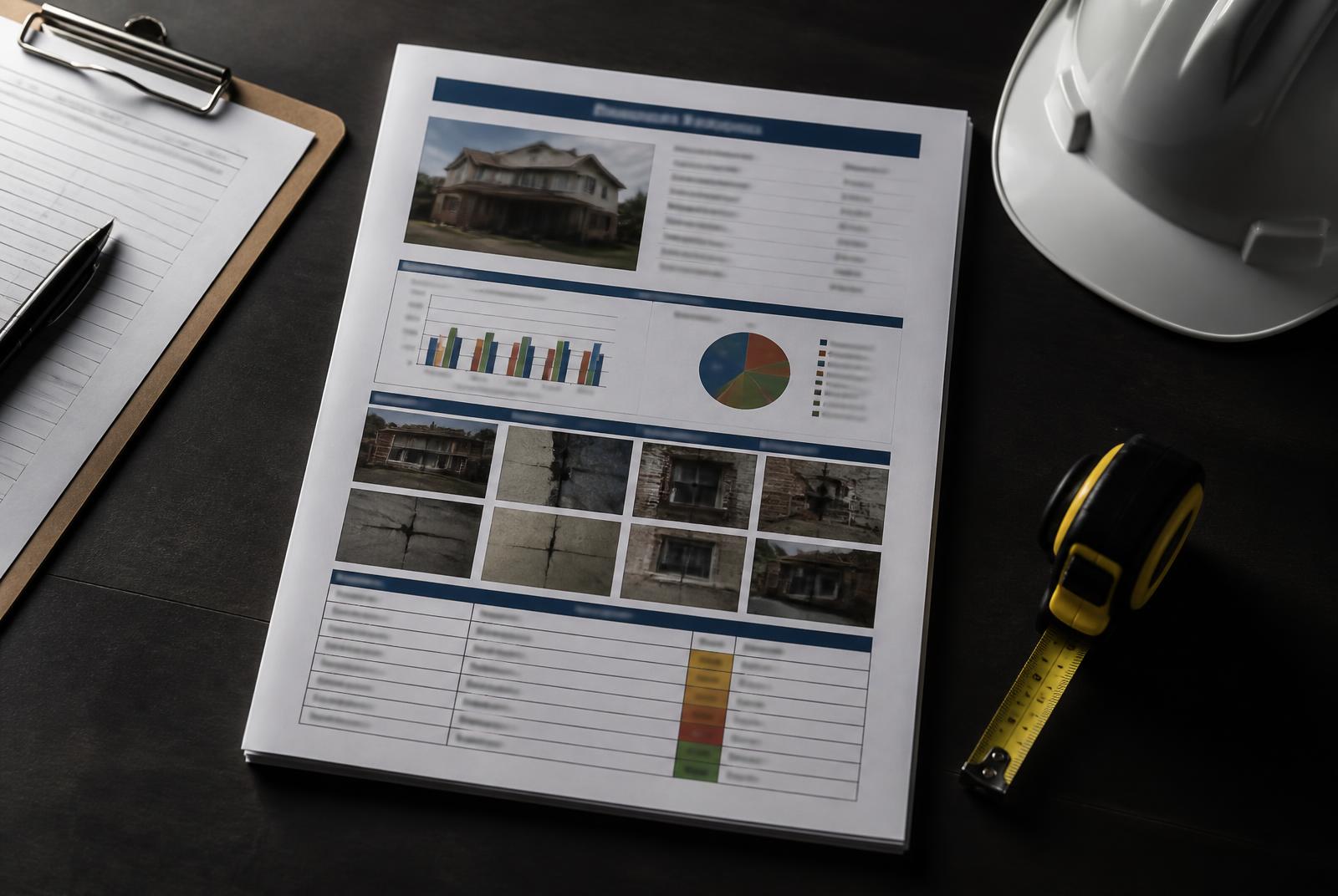
Scope & report
What is the difference between a PCA and a home inspection?
A Property Condition Assessment follows ASTM E2018, evaluates commercial systems under commercial standards, and delivers opinions of probable cost plus a multi-year capital reserve table. A home inspection follows a residential standard of practice and produces a defect checklist with no cost modeling and no lender acceptance.
All FAQ / Scope & report
Quick answer
A Property Condition Assessment follows ASTM E2018, evaluates commercial systems under commercial standards, and delivers opinions of probable cost plus a multi-year capital reserve table. A home inspection follows a residential standard of practice and produces a defect checklist with no cost modeling and no lender acceptance.
— U.S. Commercial Building Inspections (USCBI), commercial property inspectors in San Diego, CA. Serving 5 Southern California counties.
The core difference: cost modeling
A home inspection tells you a condition exists. A Property Condition Assessment tells you what it will cost and when you will pay it. That is the entire reason lenders and investment committees require a PCA: the report has to feed underwriting, reserve requirements and a hold-period capital plan, not just a repair list.
| Property Condition Assessment | Home inspection | |
|---|---|---|
| Governing standard | ASTM E2018 | State or association residential standard of practice |
| Deliverable | Property Condition Report with cost tables | Checklist and narrative of defects |
| Cost opinions | Yes, immediate and reserve | Generally excluded |
| Analysis period | 10 - 12 years typical | None |
| Lender acceptance | Yes | No |
| Records review | Permits, warranties, service history, certifications | Rarely |
| Systems | Commercial roofing, three-phase power, RTU inventories, sprinkler and alarm, dock equipment | Residential equivalents |
Why a residential inspector is the wrong tool
Commercial buildings have systems that do not exist in housing: three-phase 480V service and transformers, packaged rooftop units with economizers and direct digital controls, fire sprinkler risers and backflow assemblies, grease exhaust, dock levelers, tilt-up panel connections, and roof systems whose failure modes are nothing like composition shingle. Cost, code and remaining-life judgments in those systems come from doing the work repeatedly on commercial assets.
Where each belongs
Buying a house: home inspection. Buying, refinancing, leasing or underwriting a commercial or multifamily asset: Property Condition Assessment. Buying a small mixed-use building with two apartments over a storefront: PCA, because the loan will be commercial and the lender will require it.
A note on price comparison
Quotes that look far below market are usually residential-scope reports on commercial buildings. Before comparing fees, ask the direct question: is the report written to ASTM E2018, and does it include opinions of probable cost and a capital reserve table? If the answer is no, the two quotes are not comparable products.
Reviewed by

Maurice Bedard
Chief Inspector & Owner · CCPI, CMI, CMR
Maurice Bedard is the chief inspector and owner of U.S. Commercial Building Inspections, a Certified Commercial Property Inspector with more than 25 years in commercial real estate, construction, restoration and remediation across Southern California. He has personally inspected office, retail, industrial, multifamily and institutional buildings for buyers, owners, brokers and lenders throughout San Diego, Orange, Los Angeles, Riverside and San Bernardino Counties.
Reviewed by Maurice Bedard · Updated August 22, 2026
More about our inspectors · Questions about your building? Call 619-473-2133.
Related questions
People also ask
What is ASTM E2018 and why does it matter?
ASTM E2018 is the consensus standard for baseline Property Condition Assessments of commercial real estate. It defines the walk-through survey, document review, interviews and the Property Condition Report, including opinions of probable cost, which is why lenders and institutional investors require reports written to it.
What is included in a commercial property inspection?
A commercial property inspection covers the roof, structural system, building envelope, HVAC, electrical, plumbing, fire and life safety systems, vertical transportation, interiors, site improvements and accessibility observations, and delivers findings as prioritized immediate repair and capital reserve tables.
Does my lender require a Property Condition Assessment?
Almost always, yes. SBA 504 and 7(a), CMBS, life company, agency multifamily and most bank commercial loans require an ASTM E2018 Property Condition Assessment, and they use the immediate repair table to set a closing escrow and the capital reserve table to set your ongoing replacement reserve.
What is an immediate repair versus a capital reserve item?
An immediate repair is a deficiency that requires action now or within roughly twelve months, usually for safety, code, or to prevent accelerating damage. A capital reserve item is a system nearing the end of its useful life whose replacement is projected across the analysis period, typically ten or twelve years.
Request a quote
Get this answered for your property
Send the address, asset type and approximate square footage. We reply with scope and fee, usually the same business day.
619-473-2133
Mon–Fri 7:00am–6:00pm