
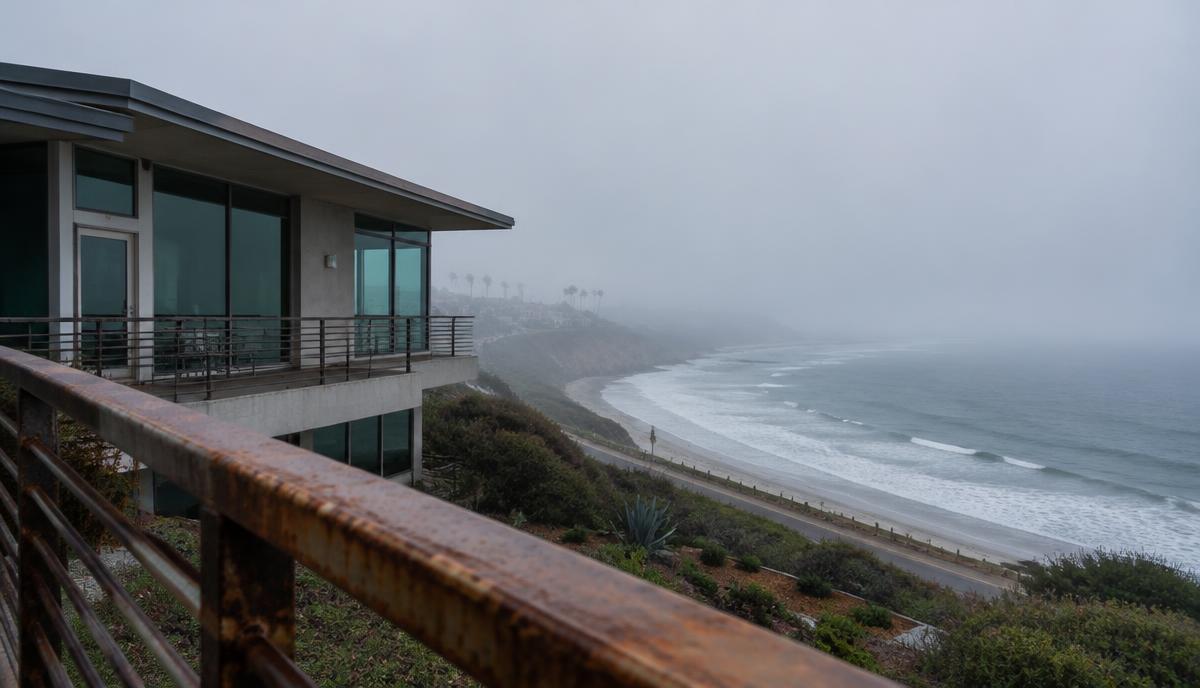
Why marine exposure changes commercial maintenance
Salt-bearing marine air can leave deposits on exposed commercial building components. When moisture is present, those deposits can promote corrosion, especially where finishes are damaged or water remains trapped. Buildings in Oceanside, Carlsbad, Encinitas, Del Mar, and coastal San Diego should account for this exposure in maintenance planning. A clean-looking façade does not necessarily mean rooftop equipment, hidden connections, or sheltered hardware is in good condition.
Exposure varies by wind direction, surrounding structures, elevation, material, and distance from the shoreline. Avoid treating a single mileage boundary as a reliable maintenance rule. Compare observed conditions at the property instead. An inland building in Vista or San Marcos may still experience marine influence, while another site’s most pressing issue may be dust, heat, or an unrelated drainage defect.
Look for early corrosion rather than waiting for failure
Begin with a documented condition survey of exposed metals and nearby materials. Note staining, blistering paint, pitting, flaking coatings, loose connections, and areas that stay wet. Photographs taken from consistent locations help reveal progression, but they do not establish the remaining strength of a component. Apparent surface rust on a support or railing may need qualified assessment if there is any concern about stability.
Look closely at joints, fasteners, cut edges, and contact points between different metals. Salt and moisture can collect in sheltered spaces that rain does not rinse effectively. Record where defects repeat instead of applying the same cosmetic treatment every time. Coating over contamination or deteriorated material may hide a developing problem without restoring protection. Preparation and compatibility matter as much as the final finish.
Tip: Key takeaway: Track corrosion by component and location so early surface changes do not become overlooked safety or equipment problems.
Protect rooftop HVAC without damaging delicate components
Rooftop HVAC equipment is exposed to marine moisture, salt deposition, and weather, often in areas occupants rarely see. Inspect cabinets, coil surfaces, fasteners, drain pans, and supports according to the equipment and site conditions. Corrosion can affect serviceability as well as performance, so note seized hardware and deteriorating panels alongside operational findings. A technician should distinguish cosmetic deterioration from problems affecting safe operation or repair decisions.
Cleaning must follow manufacturer guidance. Excessive pressure, incompatible chemicals, and improvised treatments can damage coil fins or finishes. Ask whether a proposed protective product is suitable for the specific equipment and whether it affects service or warranty conditions. Do not assume that more frequent washing is always better. The schedule should reflect actual salt loading, drainage, material condition, and the methods required to clean safely.
Inspect roof edges, flashing, curbs, and drainage together
Coastal roof maintenance should consider metal flashing, coping, fasteners, equipment curbs, and penetrations alongside the roof membrane. Corroded accessories and failing sealants can create water-entry paths even where the main roof covering appears sound. Use qualified roof personnel to evaluate suspected deterioration, and avoid letting unrelated repair crews make improvised penetrations or apply incompatible sealants. Small changes can affect drainage and existing roof details.
Before the November–March rains, arrange a review of drains, scuppers, debris accumulation, and previously repaired leak locations. Check after significant storms when safe access is available. Rain may rinse some exposed surfaces while leaving salt in sheltered areas, so rainfall is not a replacement for inspection. If an interior stain develops, investigate the source rather than assuming all coastal water intrusion comes from corrosion.
Tip: Key takeaway: Coastal roof planning should connect corrosion checks with drainage and pre-rain water-entry inspections.
Include doors, railings, lighting, and everyday hardware
Salt exposure is not limited to rooftop systems. Exterior door hardware, hinges, closers, gates, railings, and light fixtures can deteriorate in ways that affect daily use. A door that sticks may have several causes, including alignment, moisture, or corroded hardware. Record the symptom and assess the assembly rather than replacing one part repeatedly without addressing the underlying condition.
Corrosion near electrical equipment requires qualified evaluation; staff should not open fixtures or cabinets to clean internal parts. Unstable railings and loose attachments also need prompt assessment rather than cosmetic repainting. Where replacement is appropriate, specify materials and finishes suitable for the exposure and the assembly. Stainless or coated components are not automatically interchangeable, and incompatible metals or installation details can create new deterioration at the connection points.
Choose cleaning and coating methods for the substrate
Freshwater rinsing or surface cleaning can help remove deposits where appropriate, but methods should suit the material, condition, and surrounding environment. Confirm how water will drain and whether runoff needs collection or other controls under applicable stormwater requirements. Do not direct wash water into electrical equipment, roof openings, or sensitive building joints. Aggressive pressure washing can force water behind surfaces and damage finishes.
Where coating is recommended, ask what preparation is required, which defects must be repaired first, and how compatibility will be established. A coating is not a substitute for sound material or structural repair. Coordinate timing with weather and required curing conditions. Document the products and treated locations so future maintenance does not introduce incompatible layers or repeat the same unsuccessful approach without reviewing why it failed.
Set inspection frequency from exposure and consequences
Create a baseline inspection record, then use repeat observations to adjust the schedule. A highly exposed storefront near the beach may need closer attention than a protected inland courtyard, but component function also matters. Deterioration of a decorative panel and deterioration of a safety-critical attachment should not receive the same priority simply because they appear on the same façade.
Coordinate coastal inspections with broader seasonal maintenance. Inland properties in Escondido and El Cajon may put greater emphasis on summer cooling demand, while coastal sites may need additional corrosion review throughout the year. Both still need preparation for November–March rains. Track repair completion and check previously treated areas during later visits. A useful program explains not just when to inspect, but what findings trigger cleaning, repair, specialist evaluation, or replacement.
Tip: Key takeaway: Let observed exposure and the consequences of failure determine inspection priorities rather than applying one coastal schedule everywhere.
How USCBI helps coastal commercial properties plan ahead
U.S. Commercial Building Inspections and Maintenance supports commercial-only property repair and maintenance throughout San Diego County. For coastal owners, one local partner can help connect findings across HVAC equipment, roof details, exterior hardware, and general building conditions. Each client has a dedicated Service Manager and a dedicated Service Coordinator, providing clear contacts for planning, scheduling, and follow-through.
Routine inspections and quality control help keep recurring deterioration visible, while 24/7/365 emergency response supports urgent building problems when they arise. Emergency support does not replace preventive attention to exposed components. If salt-related deterioration is becoming a repeated repair issue, request a walkthrough with USCBI to review the property’s exposure, document current concerns, and discuss a practical maintenance scope that distinguishes immediate repairs from ongoing protection and longer-term planning.
Frequently asked questions
How far inland can salt air affect a commercial building?
There is no single distance that reliably predicts exposure. Wind, elevation, nearby structures, and local weather influence how marine deposits reach a property. Inspect actual conditions instead of relying on a coastal mileage cutoff. Buildings farther inland may still show corrosion, while heat, dust, or unrelated moisture problems may be more important at another site.
Will ordinary rain remove all coastal salt deposits?
No. Rain may rinse exposed surfaces but leave deposits in sheltered joints, under equipment, or behind trim. It can also introduce moisture into deteriorated assemblies. Use inspections to determine whether appropriate cleaning or repairs are needed. San Diego’s November–March rains should be part of seasonal planning, not a reason to assume the building has cleaned itself.
Should corroded HVAC coils always be replaced?
Not automatically. A qualified assessment should consider the extent of deterioration, operating performance, leakage, service history, and the condition of the overall unit. Cleaning may address deposits but cannot restore metal already lost to corrosion. Ask for a clear explanation of the findings and options before deciding between maintenance, component repair, and equipment replacement.
Does stainless hardware eliminate coastal corrosion concerns?
No material choice eliminates the need for appropriate specification and inspection. Performance depends on the material grade, finish, assembly, installation, and surrounding metals. A replacement fastener must suit both the exposure and the connection requirements. Ask for compatible materials and proper installation details rather than assuming a stainless label alone guarantees a lasting repair in marine conditions.
About the author

Maurice Bedard
Chief Inspector & Owner · CCPI, CMI, CMR
Maurice Bedard is the chief inspector and owner of U.S. Commercial Building Inspections and Maintenance, a Certified Commercial Property Inspector with more than 25 years in commercial real estate, construction, restoration and remediation across Southern California. He has personally inspected office, retail, industrial, multifamily and institutional buildings for buyers, owners, brokers and lenders throughout San Diego, Orange, Los Angeles, Riverside and San Bernardino Counties.
Written and reviewed by Maurice Bedard
More about our inspectors · Questions about your building? Call 619-473-2133.