
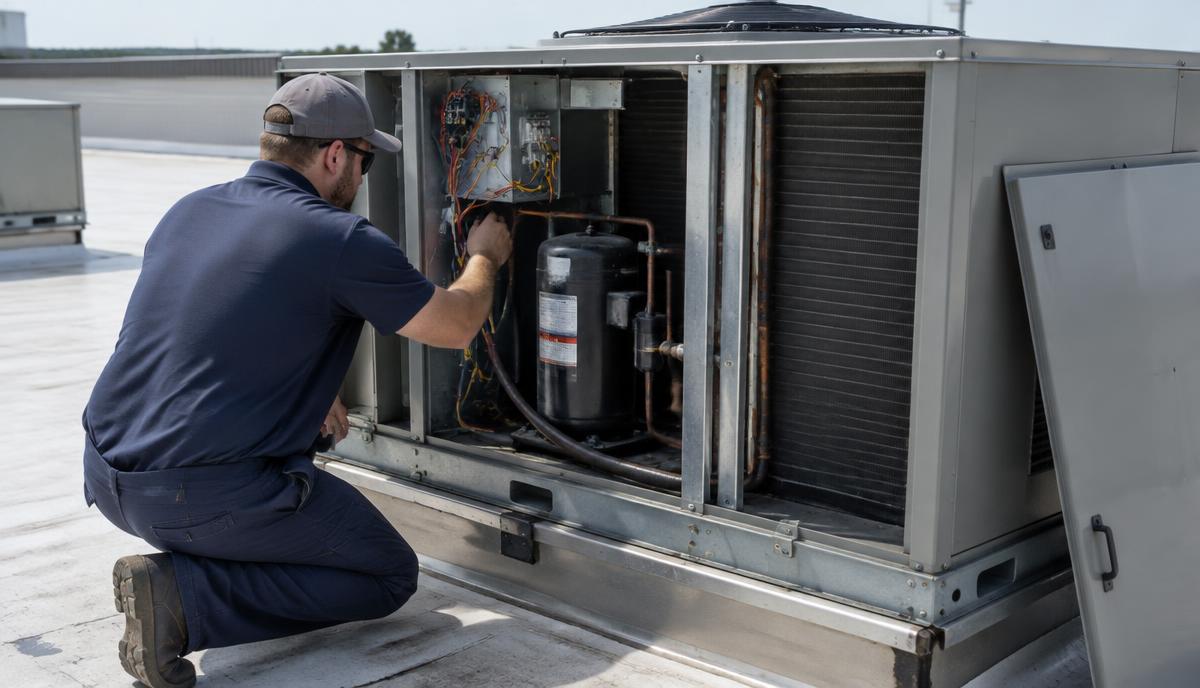
Build the schedule around the building, not a generic calendar
A commercial HVAC maintenance schedule should connect equipment requirements to the way a property actually operates. An office in Mission Valley, a retail center in Chula Vista, and a warehouse in Escondido may all use rooftop units, but their operating hours, ventilation needs, and exposure differ. Start with manufacturer instructions, equipment condition, tenant responsibilities, and any applicable inspection requirements rather than assuming every unit needs identical service.
Create an inventory showing each unit’s identification, location, model, served suites, controls, filter specifications, and safe access arrangements. Record known deficiencies before setting frequencies. A neglected unit may need corrective repairs before recurring maintenance can keep it dependable. The resulting calendar should identify who performs each task, what evidence confirms completion, and who approves additional work.
Check filters and operating conditions regularly
Use monthly filter inspections as a practical starting point, then adjust replacement intervals to actual loading and manufacturer guidance. A busy storefront near a construction site can accumulate debris faster than a lightly occupied office. Inspecting a filter does not automatically mean replacing it, and a filter that looks relatively clean may still require replacement based on its condition or specified service interval.
Ask occupants about comfort patterns while reviewing thermostat schedules and visible supply and return obstructions. Furniture blocking a return grille can create complaints that resemble equipment failure. Staff should observe accessible areas only; electrical compartments and rooftop service belong to qualified personnel. Log recurring symptoms against the same unit so separate complaints become useful operating history.
- Record filter size, approved type, inspection date, and replacement date for each unit.
- Compare tenant operating hours with programmed schedules after holidays or occupancy changes.
Tip: Key takeaway: Set filter replacement intervals from documented conditions and equipment requirements, not habit.
Use periodic service visits to check the whole system
A quarterly professional service visit can be a useful planning baseline for many commercial properties, but it is not a universal requirement or a substitute for manufacturer recommendations. The scope should address coils, blower condition, belts where fitted, condensate drainage, connections, controls, and operating performance. Technicians should identify restrictions, unusual vibration, corrosion, and evidence of refrigerant problems rather than simply confirming that the unit starts.
Request a written distinction between completed maintenance, recommended repairs, and conditions requiring prompt attention. Refrigerant should not be routinely added without investigating why the charge is incorrect. Similarly, repeated drain clearing without identifying the underlying blockage may leave an ongoing water risk. Service findings should update the next visit’s priorities, especially when the same defect appears more than once.
Prepare inland equipment before summer demand
In Escondido, Poway, El Cajon, and Santee, hotter inland afternoons can place sustained demand on cooling equipment. Schedule cooling readiness work before the busiest part of the season so there is time to address discovered problems. Review coil condition, airflow, control sequences, and measured performance under suitable operating conditions. Confirm that vacant suites and recently reconfigured spaces still receive appropriate coverage.
Include tenant coordination in the plan. A technician may need access to thermostats or occupied suites, and testing can temporarily affect comfort. Agree on service windows with businesses that cannot easily interrupt operations. When several units serve a property, prioritize those with recurring faults or critical areas rather than assigning equal urgency solely because they share an installation date.
Tip: Key takeaway: Complete cooling readiness work early enough to repair deficiencies before inland heat increases demand.
Plan for coastal exposure and November–March rains
Equipment in Oceanside, Carlsbad, Encinitas, and coastal San Diego faces marine moisture and salt deposition that can accelerate deterioration of exposed components. Inspect cabinets, fasteners, coil surfaces, and supports for corrosion. Cleaning methods and protective treatments must be compatible with the equipment; aggressive chemicals or high water pressure can damage delicate fins and finishes. Let observed exposure determine whether inspection intervals need shortening.
Before the November–March rainy season, coordinate HVAC and roof inspections around curbs, penetrations, condensate discharge, and nearby drainage routes. Water below a rooftop unit may originate from condensate, roof flashing, or another source entirely. Following significant storms, arrange safe checks for new staining or debris. Do not send untrained staff onto wet roofs to investigate active leaks.
Include heating, ventilation, and control checks
Mild coastal weather does not eliminate the need to inspect heating equipment before it is needed. Have qualified personnel assess applicable heating components and safety controls according to equipment instructions. Where fuel-burning equipment is present, combustion and venting concerns require appropriate professional evaluation. Occupants should report unusual odors promptly rather than assuming they are normal seasonal startup conditions.
Ventilation and economizer operation also deserve attention where those features are installed. A stuck damper or inaccurate sensor can affect comfort and energy use even when cooling appears functional. Review schedules after tenant changes, renovations, or new equipment loads. Maintenance cannot correct an undersized system or an unsuitable distribution layout, so persistent problems may require a separate assessment of design and operating needs.
Turn maintenance records into repair and replacement decisions
Keep one service history per asset, not just a folder of invoices arranged by payment date. Record inspection findings, measured conditions when relevant, photographs, parts replaced, unresolved defects, and the next action. Compare repeated comfort complaints with service dates and occupancy patterns. Utility changes can support an investigation, but bills alone do not prove that a particular unit is failing.
Use the records to separate immediate repairs from planned improvements and future replacement allowances. A recurring fault, unavailable component, or worsening corrosion may change the repair decision. Ask for the reasoning behind each recommendation and identify uncertainties before approving major work. Review the calendar after significant repairs so new components, warranty conditions, and follow-up inspections are not overlooked.
Tip: Key takeaway: A useful maintenance record explains what changed, what remains unresolved, and who owns the next action.
How USCBI helps maintain a workable HVAC calendar
U.S. Commercial Building Inspections and Maintenance supports commercial-only property repair and maintenance throughout San Diego County. Working with one local partner helps connect HVAC service needs with roof conditions, tenant access, and other building repairs instead of treating each issue as an isolated work order. Each client has a dedicated Service Manager and a dedicated Service Coordinator to support planning and communication.
Routine inspections and quality control help keep the agreed maintenance scope connected to actual building conditions. USCBI also provides 24/7/365 emergency response when an urgent problem occurs; planned service and emergency response serve different purposes. If your current HVAC calendar is little more than recurring reminders, request a walkthrough with USCBI to discuss equipment condition, operating demands, responsibilities, and a practical schedule for your property.
Frequently asked questions
How often should commercial HVAC equipment be serviced?
Frequency depends on manufacturer requirements, equipment condition, operating hours, and exposure. Quarterly professional visits can be a planning baseline, with more frequent filter checks and seasonal preparation. A coastal retail property and an inland industrial building may need different scopes. Use inspection findings to adjust the schedule rather than treating a standard interval as a guarantee.
Should every rooftop unit use the same filter schedule?
Not necessarily. Units serving different tenants can accumulate contaminants at different rates, even on the same roof. Document the approved filter specifications and inspect loading before setting replacement intervals. Changes in occupancy, nearby construction, or operating hours may justify an adjustment. Do not substitute a more restrictive filter without checking equipment compatibility.
Does a maintenance visit include refrigerant replacement?
Routine maintenance should evaluate operating conditions and investigate indications of refrigerant problems. Refrigerant is not a consumable that should automatically need topping off at every visit. If the charge is incorrect, qualified personnel should determine the cause and recommend appropriate corrective work. The agreement should explain whether diagnostic labor, repairs, and refrigerant are included or separately authorized.
When should San Diego properties schedule seasonal HVAC checks?
Plan cooling readiness before heavy summer demand, particularly in inland communities such as Escondido and El Cajon. Arrange heating checks before cooler weather, and coordinate rooftop condition reviews before the November–March rains. Coastal properties should also address salt exposure. Exact dates should follow equipment needs, tenant schedules, and the time required to complete any resulting repairs.
About the author

Maurice Bedard
Chief Inspector & Owner · CCPI, CMI, CMR
Maurice Bedard is the chief inspector and owner of U.S. Commercial Building Inspections and Maintenance, a Certified Commercial Property Inspector with more than 25 years in commercial real estate, construction, restoration and remediation across Southern California. He has personally inspected office, retail, industrial, multifamily and institutional buildings for buyers, owners, brokers and lenders throughout San Diego, Orange, Los Angeles, Riverside and San Bernardino Counties.
Written and reviewed by Maurice Bedard
More about our inspectors · Questions about your building? Call 619-473-2133.