
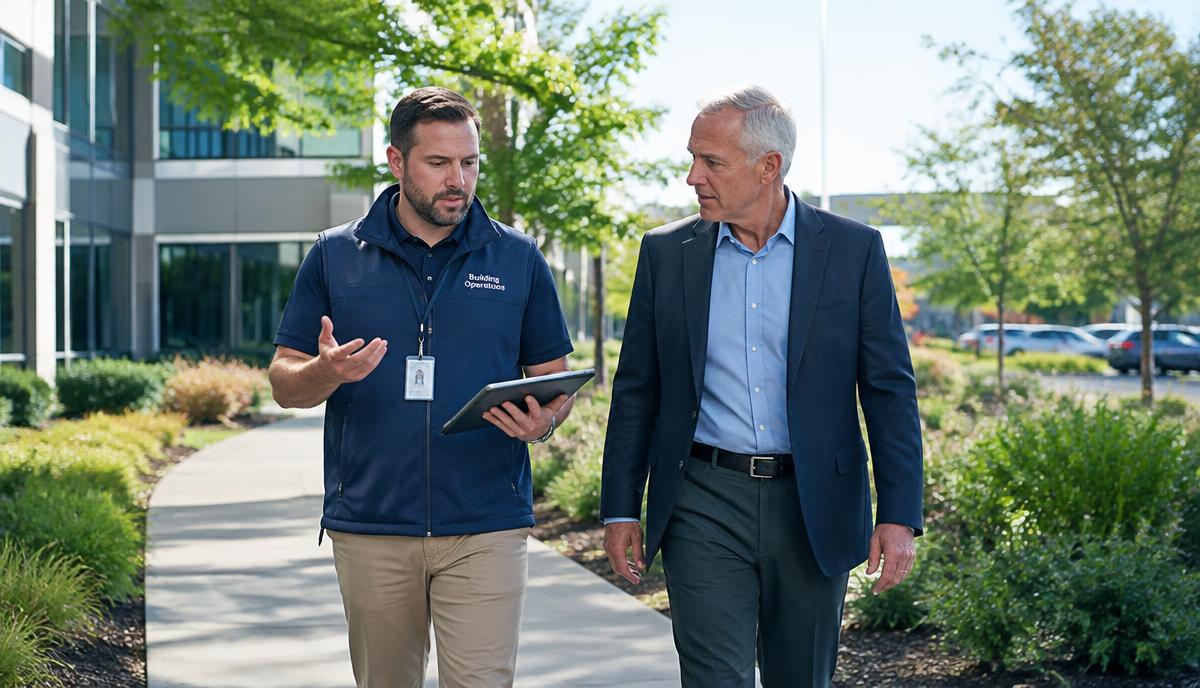
Understand what outsourced building operations actually covers
An outsourced building operations manager helps organize the work required to keep a commercial property functioning. The role can connect inspections, preventive maintenance, service requests, vendor coordination, and repair planning. It is especially useful when these responsibilities are scattered among a property manager, tenants, and several contractors. The benefit is clearer accountability, not simply another contact added to the email chain.
Define the assignment before comparing providers. A Downtown San Diego office, a Carlsbad business park, and a Chula Vista retail center have different access arrangements and operating priorities. Specify which assets and common areas are included, what authority the provider has, and what remains with the owner. An operations agreement should describe practical work and reporting rather than relying on an expansive job title.
Keep physical operations distinct from property management
Property management commonly includes leases, rent collection, tenant relations, and financial administration. Building operations focuses on physical conditions, systems, maintenance, and service execution. The responsibilities can overlap, but outsourcing operations should support the property manager rather than create competing instructions. Agree who approves repairs, communicates with tenants, and decides when work must be escalated to ownership.
Keep legal duties and specialized requirements explicit. An operations provider does not automatically take over every compliance obligation, engineering decision, or professional inspection requirement. The agreement should identify who tracks applicable inspection dates and who engages qualified specialists when needed. A responsibility matrix is particularly useful for multi-tenant properties, where lease provisions may assign some equipment maintenance to tenants and other work to the landlord.
Tip: Key takeaway: Outsourced operations works best when authority, approvals, and owner responsibilities are defined before service begins.
Replace scattered requests with a controlled workflow
Without a consistent intake process, a tenant may report a leak to a cleaner, a manager, and a contractor, generating duplicate calls while nobody owns follow-through. Establish one reporting route for routine issues and a separate escalation path for urgent conditions. Every request should carry a location, description, priority, assigned owner, and current status. That structure makes the work visible even when several trades are involved.
For each completed task, capture what was found, what was done, and whether additional work remains. Closing a work order because a vendor attended the site is not the same as confirming that the problem was corrected. Ask for a process to verify results and reopen recurring issues. The property manager should be able to identify unresolved items without reconstructing the history from separate text messages and invoices.
Make preventive inspections lead to decisions
A recurring walkthrough is valuable only when observations turn into assigned actions. Inspections should address relevant common areas, visible building conditions, and accessible systems within the agreed scope. In Mission Valley, drainage and water intrusion may deserve attention before storms; at an inland property in Escondido, cooling readiness may become a higher seasonal priority. Inspection routes should reflect the building rather than use the same checklist everywhere.
Rank findings by safety implications, operational impact, deterioration risk, and dependencies. Some defects require prompt qualified evaluation, while others belong in planned maintenance or future budgeting. Photographs and clear locations help owners understand recommendations without attending every visit. Track deferred items openly so choosing not to proceed remains an informed decision rather than a problem that disappears when the inspection report is filed.
Tip: Key takeaway: An inspection adds value when each important finding has a priority, an owner, and a next step.
Coordinate vendors, access, and seasonal work
Commercial repairs often cross trade boundaries. Water beneath a rooftop unit may require HVAC and roofing investigation, while an entry issue can involve doors, drainage, and cleaning. Central coordination helps sequence work, explain access constraints, and reduce conflicting instructions. It does not remove the need for appropriate trade qualifications or careful diagnosis, but it can make the process easier for tenants and property teams to follow.
Seasonal planning matters across San Diego County. Coastal buildings in Encinitas and Oceanside need attention to salt-related corrosion and moisture exposure; inland sites in Poway and El Cajon face heavier summer cooling demands. Prepare roof and drainage work before the November–March rains where practical. Coordinate disruptive tasks around tenant operations and identify weather-dependent work early enough to allow realistic scheduling rather than last-minute pressure.
Create budgets grounded in condition and scope
Outsourcing can improve budget visibility when the provider distinguishes routine service, corrective repairs, and capital planning. Request written scopes that explain the observed problem, proposed work, exclusions, and approval requirements. A low initial figure is not meaningful if access equipment, disposal, diagnostic work, or follow-up visits remain unclear. Compare proposals on equivalent work rather than the bottom line alone.
Use asset histories and recurring findings to identify future needs. Several minor repairs on one aging system may justify a broader assessment, while a single isolated defect may not. Maintain a record of approved work, pending proposals, and deferred risks. Outsourcing does not guarantee lower costs, but it can replace fragmented spending with clearer decisions about what is necessary now and what can be planned responsibly.
Decide whether the operating model fits your property
Outsourced operations may suit an owner with multiple small commercial sites, a property manager stretched across competing duties, or a building without enough workload for a full-time on-site operations role. It may also support an existing team that needs coordination or additional coverage. Start by identifying the gap: missed maintenance, slow approvals, incomplete records, recurring complaints, or lack of a dependable escalation process.
Assess service boundaries as carefully as service benefits. Ask how routine requests are acknowledged, how emergencies are routed, and how performance is reviewed. Emergency availability is different from a guaranteed arrival time or immediate repair completion. Agree how transitions work, who owns the records, and what happens when the agreement ends. A suitable arrangement should remain understandable when the regular contacts are unavailable.
Tip: Key takeaway: Choose an operating model that solves a defined workload or accountability gap, not merely one that promises convenience.
How USCBI provides one local point of coordination
U.S. Commercial Building Inspections and Maintenance focuses on commercial-only property repair and maintenance throughout San Diego County. The one-local-partner approach helps owners connect routine upkeep, repair needs, and building operations without managing every issue as a disconnected assignment. Each client has both a dedicated Service Manager and a dedicated Service Coordinator, supporting planning as well as day-to-day communication.
USCBI’s routine inspections and quality control help keep attention on building conditions and follow-through, while 24/7/365 emergency response provides an escalation resource for urgent problems. The specific operating scope should still match your property’s responsibilities and needs. Request a walkthrough with USCBI to review current workflows, asset concerns, tenant access, and maintenance priorities, then discuss where coordinated building operations could support your existing management team.
Frequently asked questions
Does outsourcing building operations replace my property manager?
Usually the roles are complementary. Property management commonly handles leases, finances, and broader tenant relationships, while operations focuses on the physical building and service execution. Define approval authority and communication responsibilities so the two roles work together. The agreement should also state which owner obligations and specialized professional services remain outside the outsourced scope.
Is outsourced operations suitable for a small commercial property?
It can be, especially when recurring maintenance and repair coordination exceed the time an owner or manager can reliably devote. Suitability depends on equipment, occupancy, service demands, and existing staff support rather than floor area alone. Start with a walkthrough and a defined scope, then assess whether the arrangement resolves a real coordination or coverage gap.
What reports should an owner request?
Ask for open and completed work orders, inspection findings, unresolved deficiencies, proposed repairs, and upcoming maintenance. Reports should identify locations, priorities, approvals needed, and next steps. Photographs can help explain conditions, but useful reporting is not measured by length. Owners should be able to see what remains unresolved and which decisions are waiting on them.
Does emergency availability mean an immediate repair is guaranteed?
No. Emergency availability means there is a response path for urgent issues; arrival and repair completion depend on the situation, safe access, staffing, weather, and parts. Contracts should distinguish acknowledgment, dispatch, site attendance, temporary stabilization, and permanent repair. USCBI offers 24/7/365 emergency response, with property-specific escalation details best discussed during scope planning.
About the author

Maurice Bedard
Chief Inspector & Owner · CCPI, CMI, CMR
Maurice Bedard is the chief inspector and owner of U.S. Commercial Building Inspections and Maintenance, a Certified Commercial Property Inspector with more than 25 years in commercial real estate, construction, restoration and remediation across Southern California. He has personally inspected office, retail, industrial, multifamily and institutional buildings for buyers, owners, brokers and lenders throughout San Diego, Orange, Los Angeles, Riverside and San Bernardino Counties.
Written and reviewed by Maurice Bedard
More about our inspectors · Questions about your building? Call 619-473-2133.